Snap a Photo. Decode the Hallmark.
You've found something gold at the back of a drawer. A ring from a relative. A chain from a holiday years ago. A bracelet you bought when you were twenty and now have no memory of.
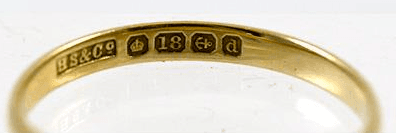
You turn it over. You see tiny stamps - a number, a shape, maybe a letter. You haven't a clue what any of it means.
You shouldn't have to.
Try the Hallmark Identifier ->
Snap a photo. Get an honest read in seconds. Free. No sign-up. No install.
The bit nobody else will tell you
A 925 stamp does not prove a piece is silver. A 750 stamp does not prove a piece is gold.
Anyone with a metal punch can stamp anything onto anything. A real hallmark is a combination - fineness mark + assay-office mark + sponsor mark - applied by an authorised office. That's the difference between a stamp and a hallmark.
Most photo identifier tools won't say this out loud, because it complicates the demo. We will. The whole point of our tool is that it knows the difference, and tells you which one you've got.
What was wrong with the old way
Hallmark guides - including our own - assume you already know what a leopard's head looks like, what a sponsor mark is, and which way round the Birmingham anchor sits. If you knew that, you wouldn't need the guide.
Generic AI chatbots are worse. We tested them. Show them a clear 925 stamp on a ring and most will tell you it's sterling silver. Show them the same 925 stamp punched into a base-metal counterfeit - visually identical from the outside - and they'll tell you it's sterling silver again. Confidently. With no caveats.
To be clear: no photo tool, including ours, can prove what metal sits beneath the surface. What a good photo tool can do is distinguish a complete, credible hallmark from a lone stamp that should be treated with caution - and tell you when the photo itself isn't good enough to call it either way.
That's what we built.
How it works (the short version)
Our identifier is a focused tool, not a chatbot. It does one job: read the stamps on a piece of jewellery, look them up against a curated UK hallmarks reference, and return a structured, honest result.
Every photo you upload goes through more than one pass.
The first pass is a fast check. Is this actually a stamp on metal? Is it sharp enough to read? Is anything obscuring it? If the photo isn't good enough, the tool tells you exactly why - zoom in, turn off your flash, tap to focus, move into daylight - instead of forcing an answer. We refuse to identify what we can't actually see.
The second pass is the expert. A vision model briefed on a curated reference set: UK assay-office marks (London, Birmingham, Sheffield, Edinburgh), the Vienna Convention common-control marks, international fineness conventions, and crucially the plate marks that look like solid-metal hallmarks but aren't (EP, EPNS, GP, GF, RGP). It returns a structured reading: purity, metal, country, assay office, date letter - with a confidence score on every field.
We can swap the underlying model - Anthropic, Google, OpenAI - and compare them. You'll never see that part directly, but it's why the answers will keep getting sharper as we tune which model to trust where.
A different kind of hallmark tool
There are good static guides. There are guided hallmark wizards. There are generic AI jewellery apps. They each do something useful.
Ours is different on three counts:
- It's built by a UK precious-metals dealer. We buy and sell this stuff every day. The tool reflects how we actually look at a piece - fineness mark first, assay office next, sponsor mark, then everything else. Not a generic "what's this object" classifier.
- It's web-based and free. No app store. No login. No paywall after three uses. Open the link, snap a photo, get an answer.
- It tells you when it doesn't know. Every reading carries a confidence score. Solid-metal verdicts come with an XRF-test recommendation, because hallmarks can be forged and we'd rather you know that up front than discover it later.
That last one is the difference between a tool that tries to look clever and a tool that tries to be useful.
How to get the best result
The single biggest factor is the photo. The hallmark needs to fill the frame and the camera needs to focus on it.
The trick most people miss: switch your phone to 0.5× (ultrawide) and bring the lens right up to the stamp. Modern phones use the ultrawide as a macro lens at close distances - you'll get sharper detail than pinch-zooming on the main camera. Tap the stamp on the screen to set focus, hold for a second, then snap. Natural light beats the flash every time.
Help us make it sharper
This is day one. The tool works, but it isn't perfect. We'll get some hallmarks wrong, especially worn marks, unusual ones, and non-UK marks where our reference data is thinner than it is for British hallmarks.
When that happens, the thumbs-up / thumbs-down buttons under each reading feed straight back to us - and a real person on our team reads every single piece of negative feedback and uses it to improve the tool.
If you have a piece you've been wondering about, or a stamp that's been driving you mad, give it a go. Tell us where it shines and tell us where it falls down.
We'll keep posting as it gets sharper. Watch this space.